

Swing for the Fences
Wisconsin Wheelchair Softball
Speed and the Long Ball!
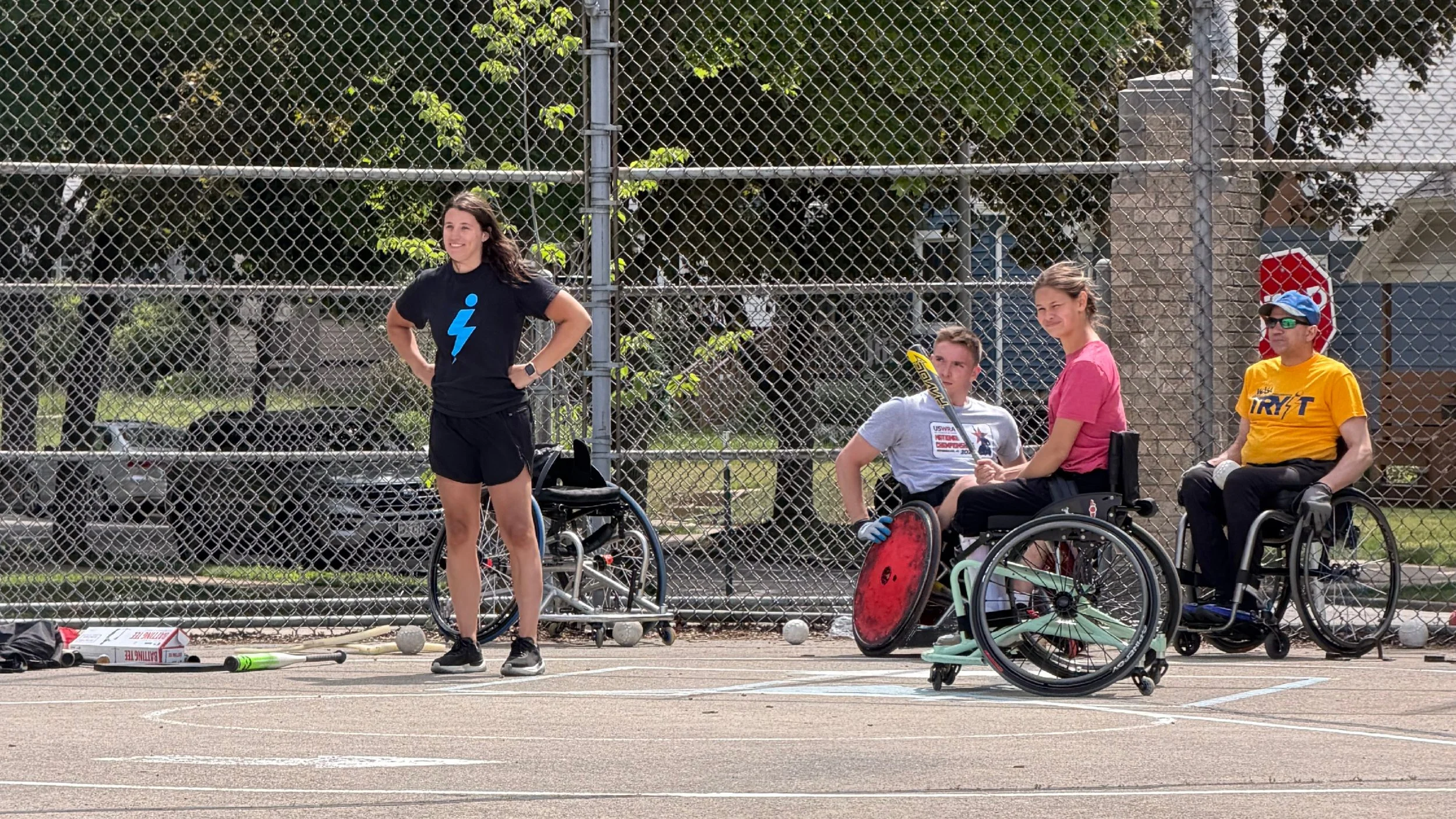
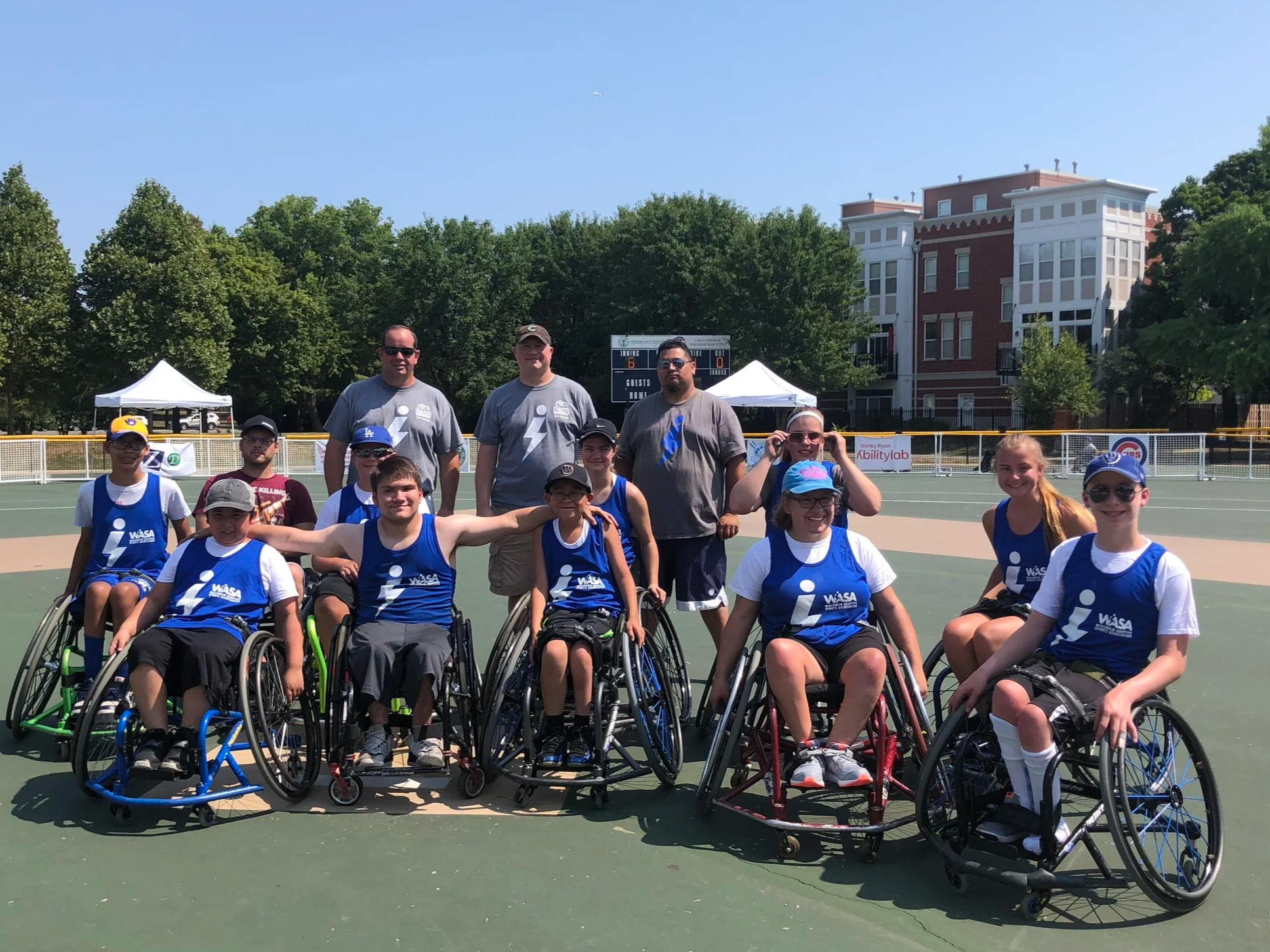
The WASA Lightning Softball Team practices outdoors from June to September, once a week in Milwaukee.
We teach and train athletes (ages 14+ beginners & advanced welcome) how to play Wheelchair Softball, aiming to provide all athletes with the ability to learn how to be successful as athletes and adults/students.
The season may also include weekend clinics and/or scrimmages.
Upcoming Softball Events:
Wheelchair Softball FAQs
-
Wheelchair softball was born in the Midwest by a few individuals with spinal cord injuries and lower extremity impairments, who still wanted to enjoy America’s greatest pastime. These individuals needed to develop a way of playing without the full use of their legs that would allow easy maneuverability in a wheelchair and keep the fast pace of softball. Thus was born a new game played on hard surfaces, such as a parking lot, instead of the normal grassy infield, and a 16-inch softball, which allows wheelchair players to keep one hand on the wheelchair while catching a softball without a glove.
In 1976, the National Wheelchair Softball Association (NWSA) was founded and served as the governing body for wheelchair softball in the United States and around the world. The game is played under the official rules of the 16-inch slow-pitch softball as approved by the Amateur Softball Association of America with some rule modifications that are made for the wheelchair user. Teams throughout America compete on a regular basis and hosts several tournaments throughout the summer. NWSA holds the Wheelchair Softball World Series (WSWS) annually to determine an annual champion.
-
Athletes with lower‑limb impairments
Examples include spinal cord injuries, amputations, cerebral palsy, spina bifida, muscular dystrophy, or other conditions affecting mobility.
Athletes who use a wheelchair for sport or daily mobility
You don’t need to use a wheelchair full‑time — many players are ambulatory but use a sport wheelchair for safety and competitive balance.
Youth, adults, and veterans
Wheelchair softball is intentionally inclusive across age groups and experience levels.
NOT ELIGIBLE
Individuals whose disability does not affect mobility (e.g., visual impairment alone, upper‑limb impairment alone).
Individuals without a permanent physical disability.
-
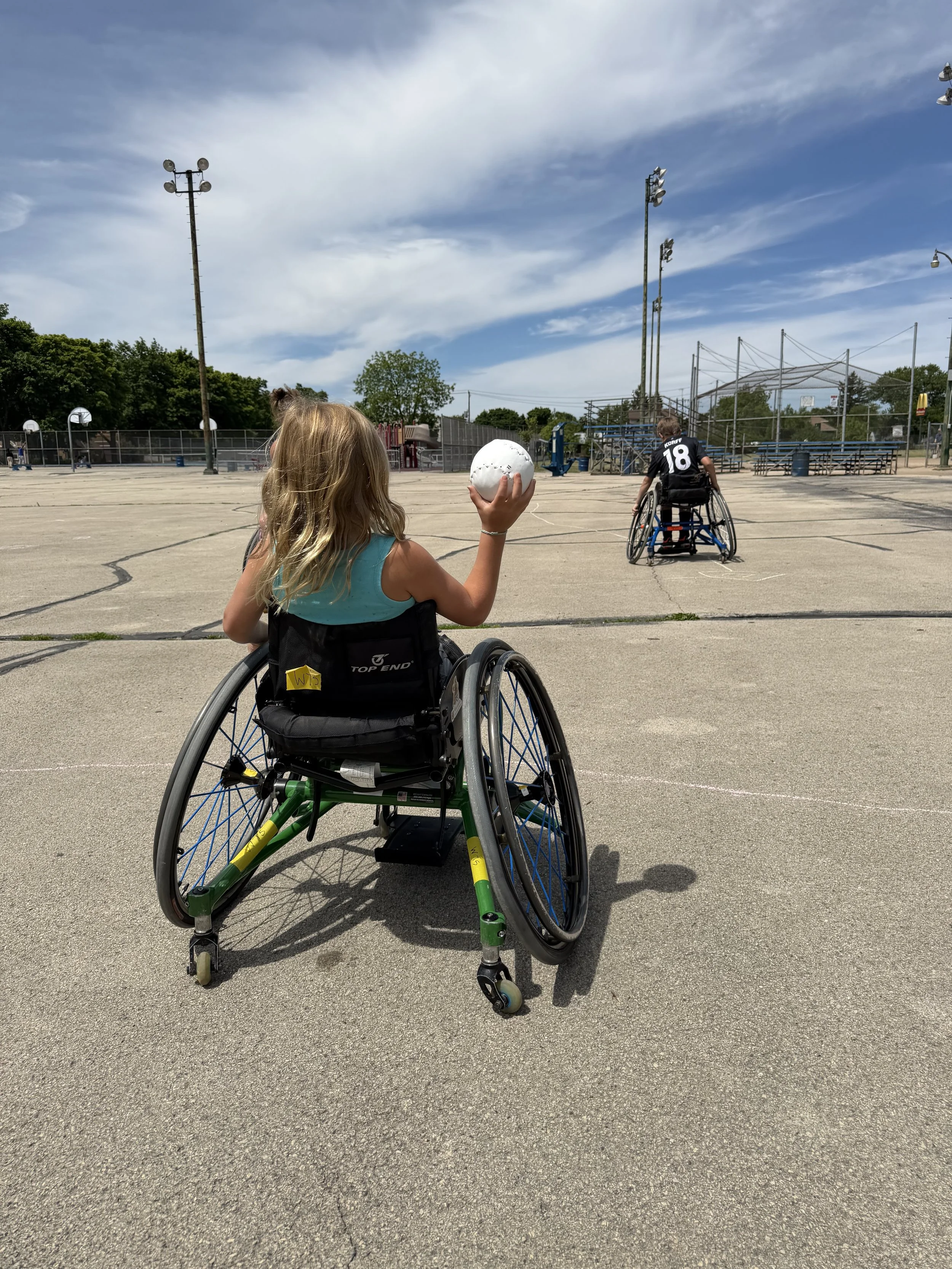
Wheelchair Softball has several key differences from traditional softball. The game is typically played outdoors in a parking lot or indoors on a smooth concrete floor, and players use sports wheelchairs for mobility. The softball has a 16 in circumference and no gloves are used for catching the ball.
-
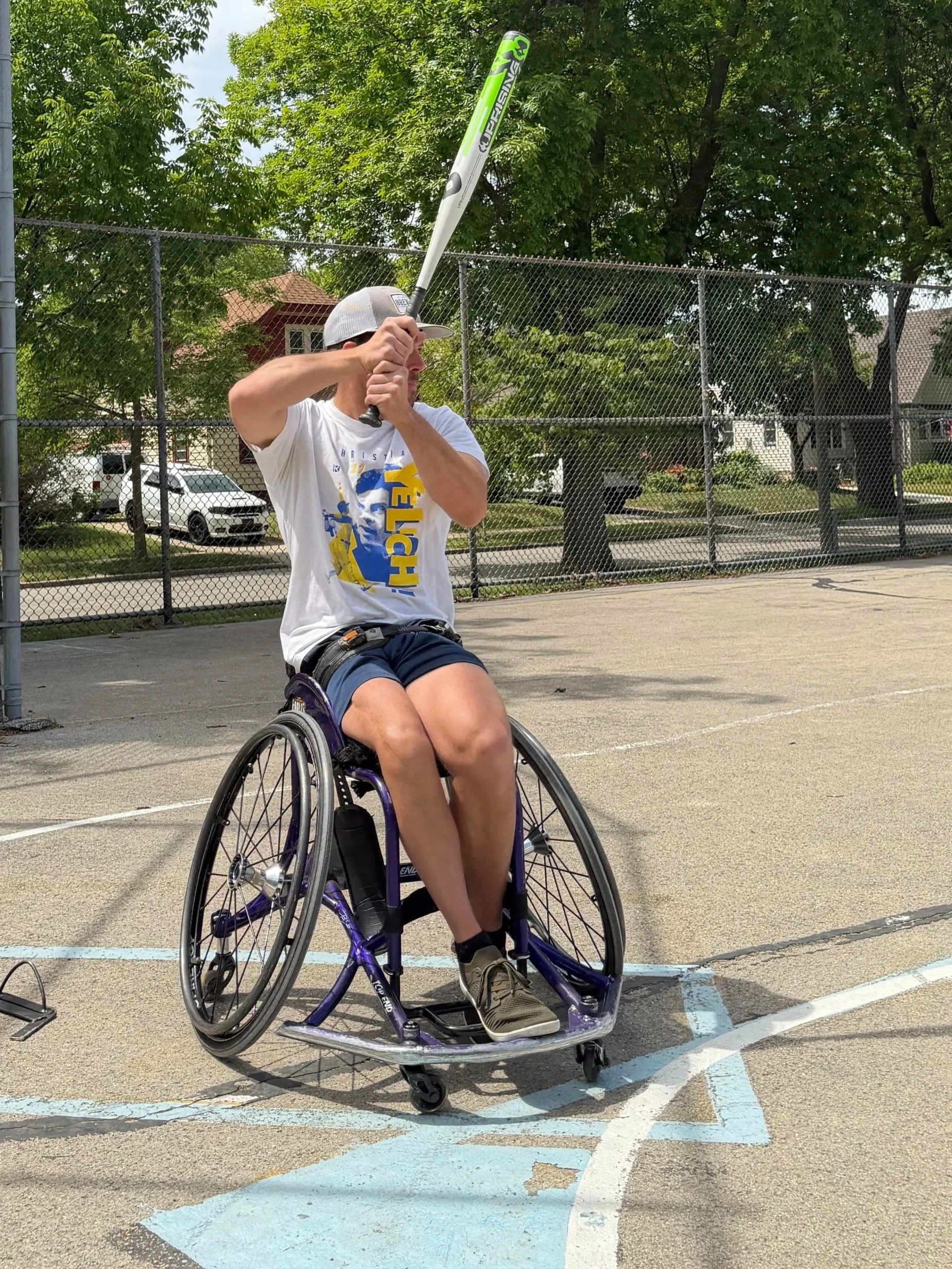
Essential equipment for Wheelchair Softball includes a sports wheelchair, a bat (standard baseball/softball), and a ball (16 in circumference). The wheelchairs used are typically designed for agility and speed. Some players may also use additional straps for stability.
-
If a team cannot field a Quadriplegic player, the team can play with 9 players. Team cannot exceed points of 25 and the tenth batter is an automatic out.
The “Chop Hit” is allowed in the National Wheelchair Softball Association.
All participants must be in manual wheelchairs with foot platforms.
The defensive baseman and the base runner must touch the circle with one or more wheels in order to tag the base, these wheels include the 1-2 front caster wheels and the two rear wheels. Anti-tip casters are not considered as a wheel.
The base runner must be seated in his/her wheelchair and may tag or make contact with the base with either one or more wheels, or may tag the base with his/her hand. If a runner is knocked out of his/her chair, he/she may proceed to the previous or next base by any means other than hopping, walking, or running, and make contact with the base with any part of his/her body. A base runner may not place a lower extremity (waist down) on the ground or someone else’s chair to stop his/her chair. If he/she does, the play is dead will result in a delay dead ball situation.
No fielder may advance toward or play the ball with any lower extremity in contact with the ground. A player may return to his/her chair and then advance toward the ball. The infraction will be treated as a delayed dead ball, subject to established ASA rules.
The hitter cannot have a lower extremity in contact with the ground when hitting. If he/she does, the ball is dead, the batter is out, and all base runners return to the last base achieved before the illegal at-bat.
The ASA rule subject to the EXTRA PLAYER (EP) is not legal in wheelchair softball.
All 4 infielders must have at least one wheel on the line or on the infield area side of the restraining line until the ball leaves the pitcher’s hand. If any infielder fails to observe the restraining line rule, the umpire will immediately award the 1st base to the batter. The infraction shall be treated as a walk.
All outfielders other than the short fielder must remain behind the outfield restraining line until the pitcher releases the ball during a pitch.
Lifting is the act of raising the player's buttock's so that both cheeks are no longer in contact with the seating platform of the wheelchair or the cushion where a cushion is used on the wheelchair in order to gain an unfair advantage. The infraction will be treated as a delayed dead ball subject to established ASA rules.
Quadriplegic players can bunt in the National Wheelchair Association but must inform the umpire before first at-bat of quad status during any given game.
The player classified as a quad may alter their bat to improve the grip. The altered bat must be approved by the head umpire for safety concerns (no sharp or pointed edges, etc.).
The player classified as a quad may wear a glove on either or both hands regardless of position (including pitcher).
Overthrow. If a pickoff throw by the pitcher or catcher results in an overthrow or blocked ball, runners may advance a maximum of one base after retouching the original base. All base runners may advance at their own risk.
-
Teams are balanced by the following point system: Quadriplegic Player (any) = 0 & .5 point; functional classification system will be observed (1.0 - 4.5). Women and Juniors shall play at one classification less than their NWBA woman division classification. NWSA will use the classification system of the National Wheelchair Basketball Association (NWBA) and the United States Wheelchair Rugby Association (USWRA) to determine point values for players.
At no time in a game shall a team have players participating with a total value of points greater than 28.
The coach, in placing his/her team’s roster in the official score book before each game, shall place a number prominently and in a common line between the player’s disability classifications. The official scorer shall be responsible for seeing that personnel on the field for either team at any given time does not exceed the above balance rule. This will only have to be checked at the beginning of the game and at time of substitutions. No checking of the total value points will be necessary if an athlete substitutes for the same value. It will only be necessary if substitutes for high point for low point.
Quadriplegic Player Requirement. At no time in a game shall a team have players participating with a total value of points greater than 28. If a team does not roster a quadriplegic player or the quadriplegic player cannot continue to play in a game, that team will be limited to 25 classification points and an automatic out will be called at the quadriplegic player’s original batting position or every tenth batter. If a team roster’s a quadriplegic player, that team is required to have a quadriplegic player in active play at all times.
Have other questions or want to get involved?
We’d love to talk! Contact Romie Meyer jeromie@wasa.org to learn more.